Newark, New Jersey
The InnocentNewark, New Jersey is more than a backdrop: it is the city where Matt Hunter tries to resume a life after prison, where the past remains visible in familiar streets and buildings, and where the investigation around him turns deadly. The contrast between the place Matt remembers and the city he encounters gives Newark a role in the novel’s linked concerns with return, abandonment, and the difficulty of leaving the past behind.
Cityscape and Decline
A rust-red beer bottle rises above the neighborhood Matt sees when he steps outside his aging two-family home. Standing 185 feet tall, it once served as a water tower for the Pabst Blue Ribbon brewery, which closed in 1985. Its copper-plated steel, glossy enamel, gold stopper, and nighttime spotlights belong to an earlier, more polished version of the landmark. By the time Matt sees it, the label has disappeared and the bottle’s former beer-brown color has become rust red. The surrounding neighborhood, too, seems not to have collapsed all at once but to have slowly disintegrated.
That deterioration echoes a broader history Matt tries to make sense of. Near Branch Brook Park, he remembers playing tennis as a child, including a period when he competed and ranked in the boys’ fourteen-and-under division. His parents once drove him to tournaments in Port Washington every other weekend. The family stopped coming to the area before his tennis career ended, and Matt never understood what had happened to Newark. He recalls it as a thriving community, then considers how wealthier residents moved away during the suburban migration of the 1950s and 1960s. He recognizes the role of the late-1960s riots and racism, while admitting that these explanations do not account for everything he senses in the city’s abandonment.
Matt’s Return and Working Life
Newark is where Matt attempts to build an ordinary life after prison. His brother Bernie buys him a partner desk, and for six years the brothers share an office in the city. Bernie practices lucrative corporate law; Matt, barred from practicing as a conventional attorney because of his felony conviction, takes less lucrative work. Their arrangement is unusual to Bernie’s law partners, but its physical closeness suits Matt: the brothers had shared a bedroom throughout childhood, with Bernie sleeping in the upper bunk. The desk and office make their renewed partnership concrete, even as Matt’s legal status marks the limits of his return.
The attempt at restoration is uneasy. Matt sits at the old two-person desk, with Bernie’s side empty, while the story of the Hunter Brothers being back on track competes with the fact that Matt’s prison years cannot simply be erased. The city provides the setting for this strained balance between a familiar family bond and a changed social position.
Newark also holds the ordinary institutions and professional contacts around Matt’s work. He belongs to the Newark Museum, where the guards know him and he can enter without needing to show his membership card. He walks through the west-wing gallery, past a recent painting by Wosene Worke Kosrof and up to the second floor, where a woman stands in front of an Edward Hopper painting. Elsewhere, a large private-investigation firm, MVD, operates from a glass building near Matt’s office. These details place his professional life within a city of identifiable workplaces, cultural spaces, and recurring routes rather than an abstract urban setting.
Investigation and Violence
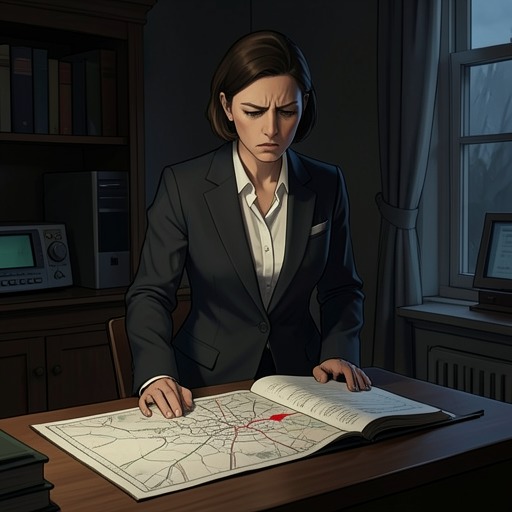
Newark becomes a point of convergence in the case surrounding Matt, Olivia Hunter, and Charles Talley. In reconstructing events, Loren Muse explains that Matt brought Cingle Shaker photographs and video, that Cingle identified Talley and found him at the Howard Johnson’s near Newark Airport, and that Matt and Cingle went there to confront him. The confrontation ended with Matt injured and Talley dead. Her account presents the city as a place where private investigation and personal confrontation intersect, and where the evidence gathered by one person can draw another into a fatal encounter.
The city’s hotels also figure in a separate account of extortion. A woman recounts checking into a Newark hotel after arranging a meeting with people who claimed they could help save her daughter’s life. A man directed her to Room 508, searched her bag and took her phone, then demanded money after revealing that he knew who she was. The episode makes Newark’s rooms and meeting places part of a trap: a location arranged under the promise of help becomes the setting for a threat and a demand for payment.
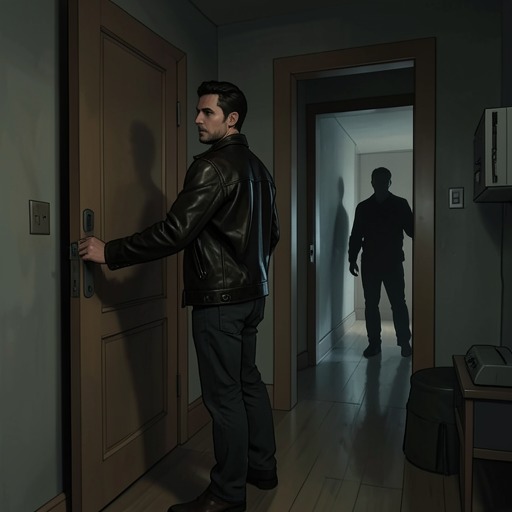
The violence connected to the investigation is confirmed through reports from Newark. Loren tells Matt that Max Darrow has been found shot dead in the city. Soon afterward, Matt learns that Talley’s body has been found at the Howard Johnson’s, along with bloody brass knuckles; authorities plan DNA testing and expect to retrieve photographs from Matt’s phone. These discoveries turn Newark from the setting of Matt’s return into the place where the case produces evidence against him and where the consequences of his confrontation become public and immediate.
The City as a Narrative Pressure
Newark is repeatedly linked to both familiarity and estrangement. Matt knows its streets through childhood, tennis, his office, and the museum, yet he cannot fully explain its decline or treat his own return as a simple homecoming. The old beer-bottle tower captures that tension: a once-bright civic landmark remains in place, but its color, missing label, and decaying surroundings register the loss of its earlier life.
The city’s plot functions are equally double. It gives Matt a workplace and family foothold, but it is also where murders are discovered, where a hotel meeting turns into blackmail, and where an investigation closes in on him. Near the end of the cited events, Loren hears a radio report of a murder in Irvington, close to the Hunters’ home, and of a large man seen chasing a woman. The report does not yet establish what happened, but the nearby setting and the description of the man intensify the threat surrounding Olivia. Newark and its adjoining neighborhoods thus connect Matt’s daily life to the danger he cannot keep at a distance.